Land Clearing & Excavating



Texas Land Authority designs and installs complete rainwater harvesting and collection systems for homes, ranches, and rural properties in Blanco, Texas 78606 and surrounding Blanco County.
From properties near the Blanco River and downtown Blanco to acreage along US Highway 281, RM 1623, RM 165, and the rural roads surrounding town, we build rainwater systems around the property, available catchment area, water needs, and intended use.
Our turnkey installation services can include site preparation, rainwater storage tanks, trenching, plumbing, pumps, electrical work, filtration, treatment, testing, and final system startup.
Looking for a more reliable way to collect and store water on your Blanco property?
Request a Rainwater System Consultation

Water has always been closely tied to life and land in Blanco. The community developed along the Blanco River, which flows directly through town and Blanco State Park. Texas Parks and Wildlife notes that springs from the Trinity Aquifer feed the river before it continues southeast through the Hill Country.
Today property owners not only face the threat of prolonged natural drought, but also the increased depletion of critical water resources due to overdevelopment and urban sprawl.
Rainwater harvesting provides another way for Blanco residents to make use of the rainfall that already reaches a home’s roof.
A properly designed rainwater collection system can capture, store, filter, and distribute that water for uses ranging from landscaping and livestock to supplemental, backup, and whole-home water supply.
For landowners near Blanco, Kendalia, and Johnson City who rely on private wells, hauled water, or other water sources, stored rainwater can also add another layer of flexibility to the property’s overall water plan.
Hill Country rainfall can be highly variable, which means periods of abundant rain can be followed by extended dry conditions.
Instead of allowing all of the water that falls on a roof to run off the property, a rainwater harvesting system captures a portion of that rainfall and stores it for later use.

Supplement a private well
Reduce how much of the property’s water demand must come from groundwater.
Create a backup water supply
Maintain stored water onsite for periods when another water source is limited or unavailable.
Supply household water
Use harvested rainwater throughout the home when the system is appropriately designed, filtered, and treated for the intended use.
Water landscaping and gardens
Store rainfall for use during drier periods.
Support livestock and acreage
Provide another source of water for ranch, agricultural, and land-management needs.
The goal isn’t necessarily to replace every existing water source. For many Blanco property owners, it is simply about having more control over the water available on their own land.
One call – we do it all!

.



A rainwater harvesting system is much more than a storage tank.
Texas Land Authority coordinates the infrastructure required to turn rainfall from your roof into usable stored water.


Collection potential begins with roof area and rainfall.
As a general rule, one inch of rainfall on one square foot of roof provides approximately 0.62 gallons of potential rainwater before normal system losses are considered.
That means:
2,000 sq. ft. of roof × 1 inch of rain × 0.62 = approximately 1,240 gallons of potential rainfall
The amount you can actually retain also depends on collection efficiency and available tank capacity.
This is why tank sizing should consider more than annual rainfall. A good system balances:
Roof catchment → Rainfall → Water demand → Storage capacity



The right tank size depends on your roof catchment area, expected rainfall, water use, available installation space, and how much stored water you want available between rain events.
Rather than selecting a tank based on capacity alone, it is helpful to compare tank materials, dimensions, storage options, and property requirements.
Explore Rainwater Tanks & Storage Options →
I would send this CTA to the Water Tanks hub, not directly to Aqualine or Enduraplas. Let that hub distribute the user to the appropriate brand page.
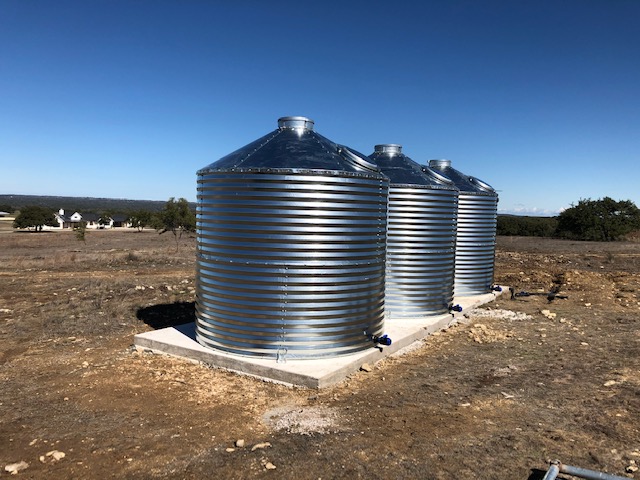

How rainwater will be used determines how it should be filtered and treated.
Rainwater intended only for landscape irrigation will have different requirements from water intended for indoor household or potable use.
A complete treatment system may include pre-filtration, sediment filtration, pumping equipment, additional water-treatment components, and disinfection appropriate for the intended application.
Texas Land Authority considers the tank, pumps, plumbing, filtration, treatment, and point of use as one integrated system rather than designing these components independently.
Texas Land Authority is a veteran-owned Hill Country company specializing in complete rainwater harvesting systems.
Instead of coordinating separate contractors for excavation, tank installation, plumbing, electrical work, filtration, and startup, property owners can work with one team to coordinate the system from site preparation through operation.
One Call. We Do It All.
Site preparation • Rainwater tanks • Trenching • Plumbing • Electrical • Pumps • Filtration • Treatment • Testing • Startup
Does Texas Land Authority install rainwater systems in Blanco, Texas
Yes. Texas Land Authority installs rainwater collection and harvesting systems for homes, ranches, and rural properties in Blanco, Texas 78606 and surrounding portions of Blanco County.
Can rainwater supplement a private well?
Yes. A rainwater collection system can be designed as a supplemental water source rather than replacing a well entirely. The appropriate configuration depends on your water demand, existing system, roof catchment, and storage capacity.
How large of a rainwater tank do I need?
Tank size depends on roof catchment area, rainfall, expected water consumption, available installation space, and desired reserve capacity. Texas Land Authority can help evaluate these factors before recommending a storage configuration.
Do you install the plumbing and electrical components?
Yes. Texas Land Authority’s turnkey installations can include site preparation, tank installation, trenching, plumbing, electrical work, pumps, filtration, treatment equipment, testing, and startup.
Do you install rainwater systems outside Blanco city limits?
Yes. Much of the Blanco area consists of rural acreage outside the city itself. Texas Land Authority serves properties throughout the surrounding Hill Country, including areas along US 281 and rural roads near Blanco, Twin Sisters, Johnson City, Kendalia, Hye, and Fischer.
How Does a Rainwater Collection System Work?
A complete system moves water through a simple sequence:
Capture → Convey → Pre-Filter → Store → Pump → Treat → Distribute
Rain falls onto the roof, moves through gutters and conveyance components, passes through debris-management or pre-filtration equipment, and enters the storage tank.
When water is needed, pumps move it through the appropriate filtration or treatment equipment and then to the designated household or property uses.
The exact configuration depends on the property and what you expect the collected water to do.
What is the service area for rainwater collection installation near Blanco’s US 281 corridor?
Blanco sits along US Highway 281, one of the primary north-south corridors through this portion of the Hill Country. TxDOT’s current Blanco County US 281 project extends from US 290 north of Blanco south toward FM 306, reinforcing US 281’s role as the central transportation spine through the county.
Texas Land Authority serves properties in and around Blanco 78606, including acreage and rural homes:
TxDOT mapping for Blanco identifies US 281 along with RM 1623, RM 165, and RM 32 as major connecting roads around the community.
Nearby ZIP areas include Johnson City 78636, Hye 78635, Kendalia 78027, Fischer 78623, Stonewall 78671, and Wimberley 78676.
Whether you’re building a new home, adding water storage to an existing property, supplementing a private well, or planning a complete whole-home rainwater system, Texas Land Authority can help determine the collection, storage, filtration, and infrastructure your property requires.
Request a Rainwater Harvesting Consultation in Blanco, Texas
Welcome to Texas Land Authority. We are a veteran-owned rainwater harvesting company serving The Texas Hill Country northwest of San Antonio, Texas. Founded with a commitment to excellence and fueled by the values instilled through military service, we bring a unique blend of precision, integrity, and dedication to every project.
Texas Land Authority
Rainwater Collection Systems
123 Spring Branch Road
Spring Branch, Texas 78070
Phone: 210-760-4435

© 2026 Texas Land Authority Rainwater Collection Systems | All Rights Reserved | Privacy Policy